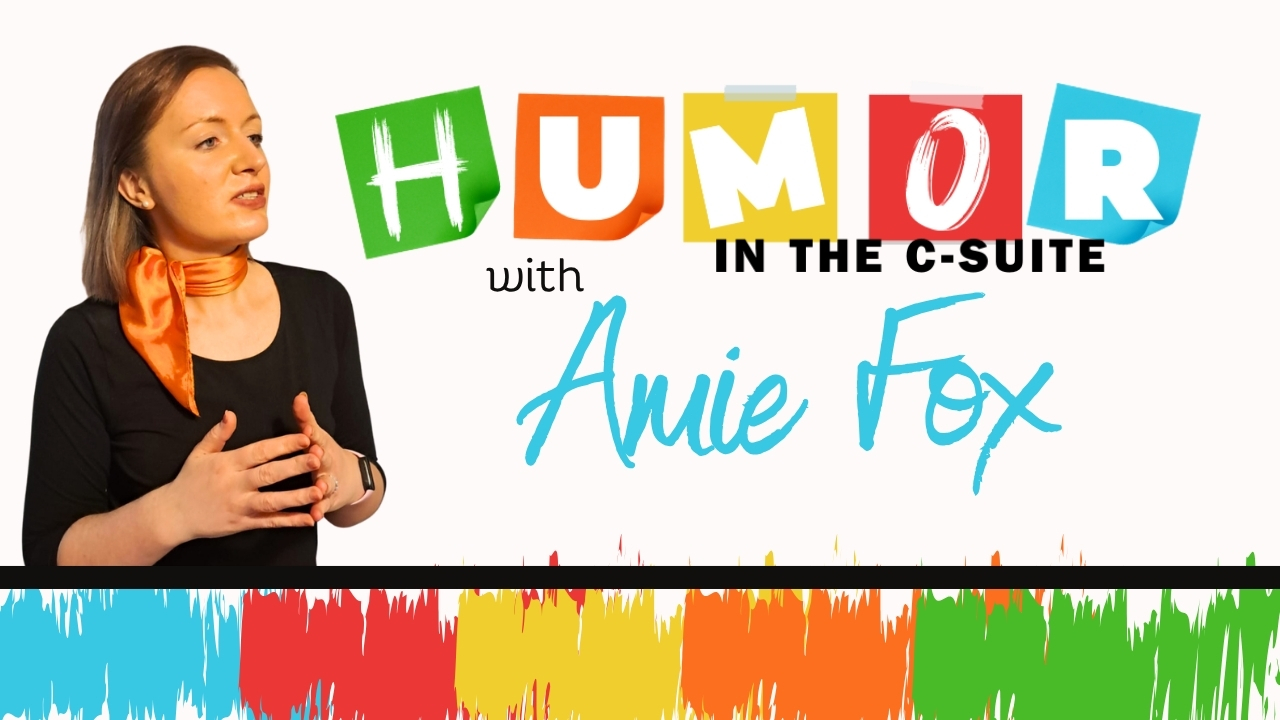
This week on Humor in the C-Suite, I sit down with Amie Fox, founder of A Fox Consulting and author of Mind the Blind Spot: Decision to Done. Amie helps people managers get good at managing people. Her whole approach rests on one idea: when people feel good, they perform at their best. Humor has been a big part of how she gets there, even though she swears she only has about three funny moments a year.
We talk about why you need to keep up with current affairs before you joke with a global team, the difference between empathy and sympathy, what to do when a joke bombs, and the keynote where Amie turned off every light in the theater.
Key Takeaways
- Know your audience first. It decides how, when and whether humor works.
- Build small “pockets of relief” into training, policies and internal communications, especially when the topic is heavy.
- Keep up with current affairs before you use humor with multicultural, multigenerational teams, so you don’t recycle a joke that now lands on someone in the room.
- Empathy and sympathy are not the same thing. Get curious about how someone works instead of feeling sorry for them.
- When a joke bombs, say so out loud, acknowledge it, and move on.
- Practice hard conversations in the good times so you’re ready when the hard times come.
“We talk about work and business and career like it’s a game. So why aren’t we having fun?”
Amie Fox
Know the Room Before You Bring the Jokes
Amie started her career in communications, and the first lesson she took from it still drives everything she does: know your audience. In training sessions, she builds in what she calls pockets of relief. That might be a punchline, a pun, or a quick animation that gives people a breather from heavy material.
She admits she probably overdoes the puns. Working with a legal firm on inclusion and diversity, there was plenty of room for jokes about judgment and balance. But the point isn’t to be a comedian. It’s to find the human moments in topics that can feel heavy, like the performance management cycle she’s redesigning for a client focused on retention. If managers don’t want to engage with something, it won’t work.
Building trust before the laugh
Amie is clear that humor has to sit alongside professionalism, especially on topics like diversity, equity and inclusion or compliance. You build trust along the way so people feel like they can exhale with you. That’s when the levity starts to help.
Why Current Affairs Matter for Workplace Humor
Many of Amie’s clients are based in Ireland, but their teams are spread across the world. Add in multigenerational workforces, and the room gets more varied every year.
Her advice, which she says will sound a little nerdy thanks to her journalism background: stay up to date with current affairs. If you don’t know what’s a hot topic right now, you might recycle a joke that offends someone who’s now in the room. And once people feel offended, they close down and stop participating.
Empathy Is Different to Sympathy
This was the part of our conversation I most want managers to hear. Amie was diagnosed with a degenerative eye condition at age 11, and she has spent much of her career working around the business case for disability inclusion.
Years ago, she had a manager who found her endlessly inspiring. How could she make tea if she couldn’t see? How did she get to the office? It came from a genuinely kind place, and it still left her, in her words, smothered in sympathy.
Sympathy is feeling sorry for someone or their circumstances. Empathy is seeking to understand someone’s circumstances so you can work with them in the best way possible. The better question would have been simple: is there a particular way we should be working together?
Progress, not perfection
I asked Amie whether she was able to push back on that kind of sympathy early in her career. She was honest: no, she just took it for years. The way she’d handle it now is very different, and she shares the story because we’re all still learning how to work together. As she put it, we’re striving for progress, not perfection.
When a Joke Bombs, Say So
Amie does a lot of keynotes and group training now, but she was once terrified of public speaking. Early on, she believed she had to get the first laugh to win the room. In reality, she says, the audience is already on your side. Nobody is sitting there hoping you fail.
She has bombed plenty of times, and she has watched jokes about disability fall flat, including some directed at her. Her approach is the same either way: point out that it’s awkward. “Well, that bombed.” Acknowledge what happened, then move on.
The keynote in the dark
Amie’s funniest story fits that advice perfectly. She was giving a keynote on employee engagement and diversity in a theater, and she wanted to reset the room. So she had every light turned off before she took the stage, and planned for them to come back up on a cue word for a big, dramatic moment.
The lights came up. She was at the complete opposite end of the stage from where she thought she’d be. Everyone waited for a punchline, so she gave them the truth: she thought she’d be over there, and she had no idea how she hadn’t fallen off the stage. It got a great laugh because it was so human.
Icebreakers Are Not Optional
Amie qualified as an English language teacher in Vietnam early in her career, where she learned to open every lesson with a warm-up activity. She used to call them games and got told off for it more than once. Today, every session she runs starts with an icebreaker, even if it’s just picking an emoji to show how you’re feeling.
Some people push back because they’re busy and want to get to the point. I love that, because that resistance is exactly why it matters. If you’re thinking about your last email or tomorrow’s meeting, you can’t take in tools like constructive feedback or coaching for development. Having those moments as a group in the good times means you’re better equipped when the hard times come.
Making room for the shy person
When Amie onboards managers into her FoxBuzz program, she asks one question: do you have a particular learning style? Most people say they’re fine with anything. There’s always one person who says they’re shy in groups. She doesn’t put them on the spot. She builds an environment where they feel comfortable, and sometimes that person ends up becoming the class clown.
AI Can’t Replace Human Connection
We’re all talking about AI changing the world, but Amie doesn’t think it can replicate human connection. On the day we recorded, she asked ChatGPT for some jokes. It couldn’t deliver, so she asked people on TikTok instead. As a comedian, I find this very reassuring.
That connection matters for collaboration, and it isn’t only about funny moments. Sometimes it’s being willing to say you’re frustrated and let the mask slip a little. Sometimes that’s humor. Sometimes it’s just honesty.
Great at Your Job? Now You Manage a Team
When Amie works with a team that’s struggling, a common symptom is that everything keeps landing back on the managing director’s desk. Many managers were great at their jobs but never got trained to manage people, and everyone in the organization knows it.
Sometimes a joke is the best way to name the elephant in the room. She has said this one to managing directors and boards: how do you know someone’s great at their job? They get lots of extra work to do and a team to manage. Once it’s out in the open, you can start fixing it.
How you pitch change matters
Amie also shared one of my favorite stories about change. When she ran internal communications at a company, a cable went missing from a boardroom. Instead of a dry notice, her team put up a poster styled like a missing person milk carton ad. It became the top post on the internal site for months. The cable eventually came back in the mail, and its return was celebrated.
Mind the Blind Spot: Decision to Done
Amie’s book, Mind the Blind Spot: Decision to Done, is about why meetings so often don’t lead to action. Of course she had to work a blindness pun into the title. It’s short on purpose, built so you can read it in an hour and use it right away. It covers communications, accountability and reviewing activities, with case studies including how Google communicates code changes and how Pixar brings projects into the boardroom for a midpoint review.
The book is available through Amie’s website, and she’s offered a free copy to listeners who get in touch.
About Amie Fox
Amie Fox is a managing director, trainer and keynote speaker who helps founders, HR and operations leaders in growing organisations build practical people systems that improve employee engagement, manager confidence and business performance.
She moved into this work after a portfolio career across communications, training, fundraising, corporate responsibility and operations exposed her to how differently people experience workplaces. A key turning point was struggling to find early employment as a visually impaired woman, which shaped her understanding of hidden barriers, workplace design and the importance of systems that help people perform at their best.
Her credibility is grounded in recent and current roles: she set up A Fox Consulting, serves as a non-executive director at Vision Ireland, and has held senior CSR and operations roles at organisations including SCOPE Eyecare & Healthcare. Through her consulting, communications, fundraising and inclusion work, she has contributed to projects with organisations such as McDonald’s, Telefonica, Deloitte, Novartis, Abbott, Newstalk and John Sisk & Sons.
Day-to-day, Amie’s work is built around the employee life cycle as the foundation for better people performance. She supports leaders and managers through coaching, training and mentoring designed to maximise employee engagement and performance across each stage of that life cycle. Her work covers practical topics including constructive feedback, strategic internal communication, coaching, setting expectations, manager routines and the day-to-day behaviours that help teams work better.
Her central thesis is simple: when people feel good, they perform at their best – but that idea only becomes useful when it is translated into clear routines, structures and systems that work in boardrooms and in daily operations. Her book Mind the Blind Spot: Decision to Done and her FoxBuzz framework are practical manifestations of that reframing.
Amie also speaks directly about the business case for disability inclusion. Her expertise is not limited to lived experience; it is grounded in practical work with companies on disability inclusion, built environmental accessibility and inclusive workplace design. She helps organisations understand that the best candidates are not missing – their hiring process may be blocking them. She also highlights that upward of 85% of people with a disability acquire those disabilities during their working lives, making disability inclusion not only a talent-sourcing solution, but also a retention strategy.
As a podcast guest, Amie brings lived experience as a visually impaired leader, media-facing storytelling from radio, television and documentary appearances, and tangible frameworks listeners can implement. Audiences leave with practical manager routines, clearer employee life cycle thinking, stronger internal communication practices, and repeatable steps to reduce the “middle manager ceiling” in growing organisations.
Connect with Amie
- Website: afox.ie
- LinkedIn: Amie Fox
- Instagram: @consultingafox
- TikTok: @afox.ie
- Book: Mind the Blind Spot: Decision to Done
- FoxBuzz: afox.ie/foxbuzz


